Why presentation design still wins business in 2026
A deck wins business when it stops a sound argument from being lost in its own delivery. It does not rescue a weak one — and pretending otherwise is how decks get overbought.


The best-looking deck we ever built did not win. The one that did was plainer, and its author could tell you in one sentence what the room had to believe by slide four. We think about that pairing a lot.
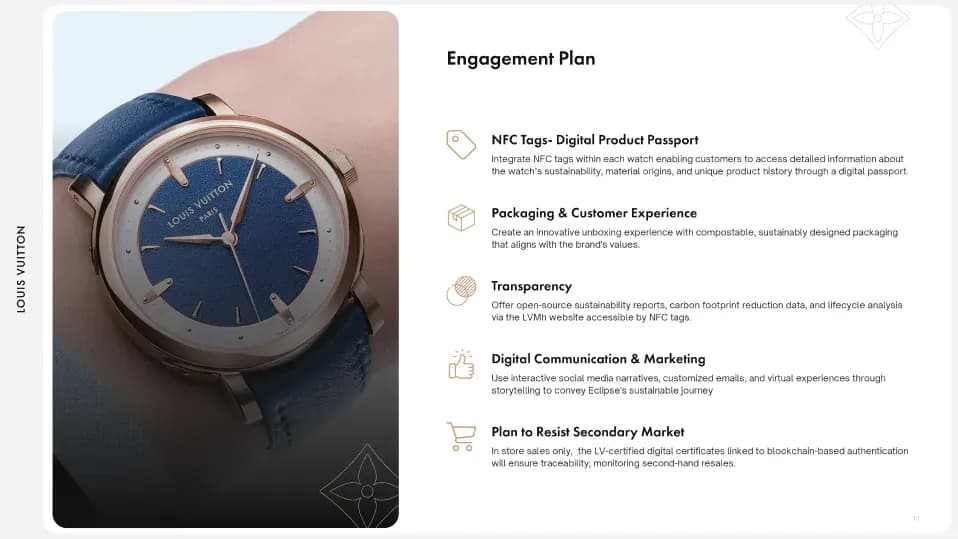
A presentation does something no proposal, email or website can: it puts a company in a room with people forming a judgment in real time. Across the decks we have built — an editorial deck for Louis Vuitton, a fifteen-slide investor deck for the medtech startup Impli — the winners shared one trait. The design served the argument, and the argument was sound. Design carried the weaker of the two only rarely, and never for long.
What the deck is actually doing
It is a live argument for a decision. It asks people to believe something and to act on it. The design is not decoration around that argument — it is the delivery mechanism. When the type fights the reader, the layout competes with the speaker, or a chart has to be explained before it can be understood, the room works harder than the content deserves. That friction is invisible from the front and completely legible from the seats.
Where a weak deck actually costs you
Not evenly. It costs most in rooms where you are being compared and a first judgment is forming: an investor deciding on a second meeting, an enterprise buyer holding three vendors side by side, a board weighing a strategy. There the shape of the argument is itself being judged. The failure modes repeat often enough to list.
- Formatting inconsistencies that read as carelessness, regardless of how strong the content is.
- Charts carrying more than a room can absorb in thirty seconds.
- Slides competing with the speaker instead of supporting what is being said.
- An opening that never establishes why this particular audience should care.
- No clear ask — everyone follows the story and nobody knows what they are deciding.
Why it compounds
A company that consistently produces clear decks builds something past any single meeting. Sales closes faster because the material carries the conversation. Board updates need less back-and-forth. Investor follow-ups begin from a shared understanding of what was said. The inverse compounds too: a run of loose, inconsistent decks trains an audience to discount your material before reading it, and no single strong deck repays that.
Why AI has not changed the maths
These tools generate layouts, reformat decks and draft slide copy in minutes, and they are good at it. What they cannot do is decide what the room hears first, where to slow down, and what to cut because it competes with the point. Those calls need an understanding of both the argument and the people receiving it. In our work the deck that wins is rarely the prettiest — it is the one where every slide has an obvious point, legible in the few seconds anyone gives it. How that gets built is its own subject: presentations that move decisions.
The honest limit
Design wins business; it does not manufacture it. A polished deck cannot save a weak case, economics that do not hold, or a product nobody wants — and a sharp room will find the gap faster, because the packaging raised the expectation. There are also rooms where the deck matters less: a warm referral, an existing relationship, a procurement decided purely on price. The claim worth defending is narrower and more useful than “good design wins”. When the decision is genuinely open and made by comparison, a well-built deck is one of the cheapest ways to keep a strong case from dying in its own delivery.
Which is why we start by writing the argument on one page in plain language: the claim, the evidence, the ask. If that page is clear, the deck has a foundation. If it is not, no design fixes it — good design only makes the confusion more legible. That is the work behind our presentation and pitch deck design, and the reason a funded investor deck starts with the story rather than the slides.
The test
Can someone who was not in the meeting read the deck a week later and rebuild the argument? If yes, the design is working. If not, the slides were a companion to a performance, not a record of a case.
Frequently asked questions
Does presentation design actually win deals, or just look good?
It wins in a specific sense: it removes friction between a sound argument and the person deciding — clearer hierarchy, one idea per slide, an obvious ask. It does not win a weak case; good design raises expectations the substance then has to meet.
When does a deck matter most?
In rooms where you are compared to alternatives and the decision is still open: investor meetings, competitive enterprise pitches, board strategy calls. In a warm referral or a price-driven procurement it carries less of the outcome.
Can we just use an AI tool to build the deck?
For internal or low-stakes decks, often yes. For a deck that has to win a room, a tool drafts the layout but not the editorial judgment — what to lead with, what to cut, what the audience must believe first.
Keep reading
All articles
Presentations that move decisions, not slides
The mechanics: one idea per slide, a first act that earns attention, and the cut that shortens the deck while sharpening the case.
Read article
What separates an investor pitch deck that gets funded from one that doesn't
A deck gets funded when an investor can repeat its thesis to a sceptical partner from memory. Everything else on the slide is competing with that.
Read articleNeed a presentation that
actually lands?
We design pitch decks, investor reports,
and keynote materials that communicate clearly and win the room.